



Share
The Caribbean’s Robotics Moment: Why Digitalisation Is a Survival Strategy, Not a Luxury
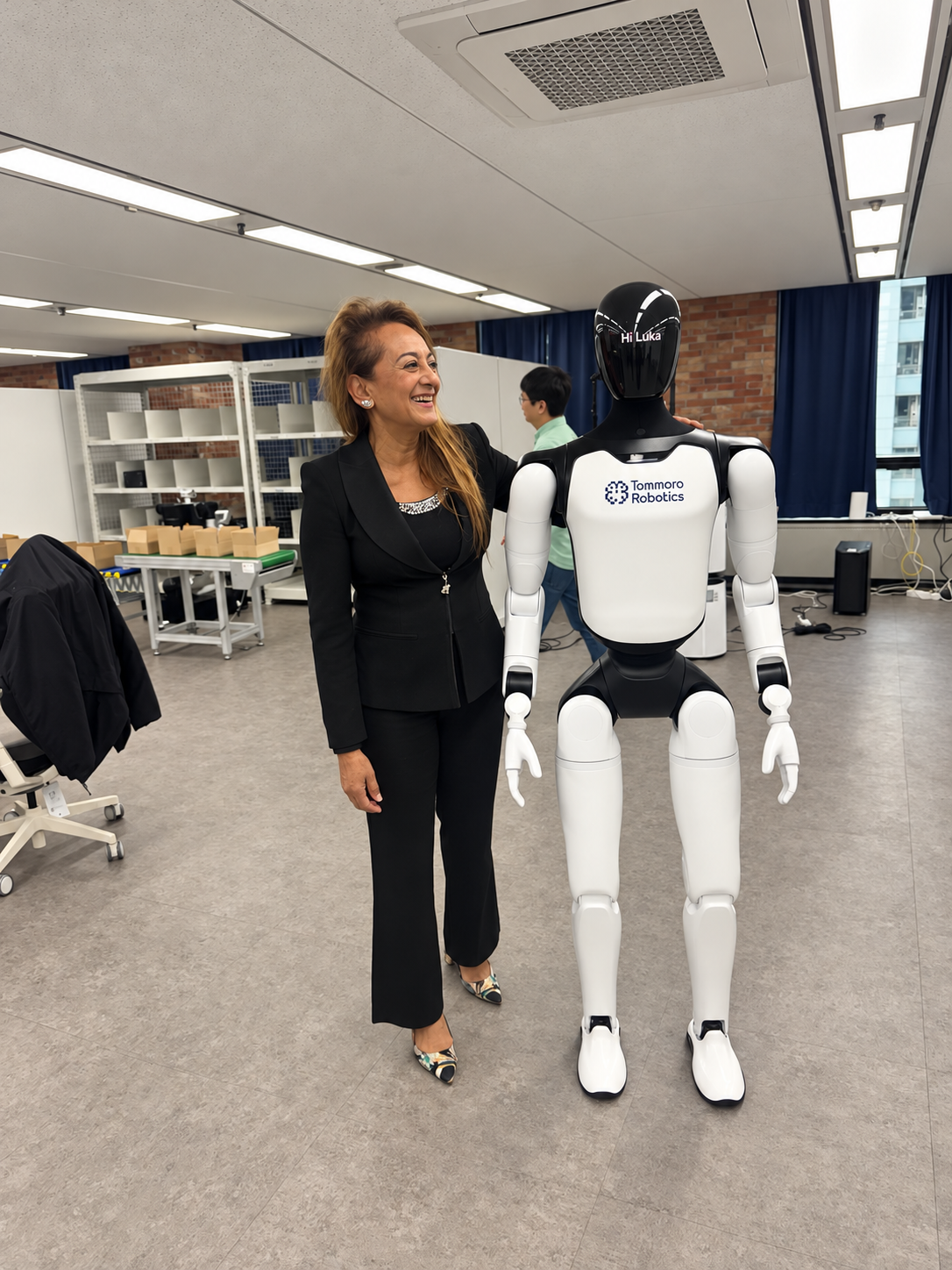
When we talk about robotics and digitalisation, the conversation usually centers on Seoul, Shenzhen, or Stuttgart. The Caribbean rarely enters the frame. That is a mistake—not because the region is on the cusp of a humanoid manufacturing boom, but because the stakes of falling behind are higher there than almost anywhere else.
For small island developing states, digitalisation is not about competitiveness in the abstract. It is about whether a government can deliver services after a hurricane, whether a young person in Kingston can access a job that hasn’t been automated away, and whether a region of 44 million people can avoid becoming a passive consumer of technologies designed elsewhere.
The Starting Point: Progress, but Uneven
The Caribbean is not starting from zero. Thirteen island states have climbed into the high e-government development tier, with the Dominican Republic and Trinidad and Tobago showing particularly strong growth in digital infrastructure and service delivery. Trinidad and Tobago has a National Digital Transformation Plan running through 2027, and the IDB opened a TechLab in Port of Spain in 2026 specifically to experiment with generative AI, social robots, and drones for smart city and digital inclusion applications.
But the gap between aspiration and execution remains wide. UNDP assessments found that infrastructure across Barbados, Jamaica, and Trinidad and Tobago remains underdeveloped, with limited progress in human capital development and research. Fewer than 20 percent of students at leading regional universities are enrolled in ICT or science programs, compared with 27 percent in OECD countries. The Caribbean is the fastest-growing region for publicly disclosed cyber incidents globally, and its regulatory frameworks have not kept pace with the digital economy.
The Robotics Question: Small Deployments, Bigger Lessons
You will not find a Caribbean equivalent of Korea’s M.AX Alliance or Hyundai’s Atlas deployment. But you will find something instructive: small-scale, practical robotics deployments that reveal both the opportunity and the fragility of the region’s digital ambitions.
In Jamaica, AIBotics acquired NovaCore Labs in late 2026, gaining a platform that includes ten service robots, six commercial drones, mapping equipment, and partnerships with the University of the West Indies and the University of Technology. The plan is not to build humanoids. It is to use drones for geospatial services, robots for automation in commercial environments, and institutional programs to build local technical capacity. The acquisition price—$225,000 in stock, with earn-outs tied to revenue milestones—tells you something about scale. This is not a billion-dollar bet. It is a foothold.
In Trinidad, the IDB TechLab is experimenting with social robots and drones as part of a broader push to build public-private partnerships around emerging technologies. And across the region, youth programs like Brightstar’s Coding and Robotics Camp are introducing students in Trinidad, Jamaica, St. Kitts, and St. Maarten to VEX Robotics and Google Teachable Machine—not because they will all become roboticists, but because the camp’s organizers understand that AI literacy is now a baseline skill across industries.
The Critical Gap: Skills, Not Hardware
The most sobering assessment of the Caribbean’s digital readiness came from a 2019 presentation by Jamaica’s Broadcasting Commission, and its logic remains relevant: automation will displace jobs in tourism, food service, retail, and finance at rates that could reach 50 to 73 percent in some sectors. The speaker noted that only a handful of countries—South Korea, Germany, and Singapore—had undertaken the curriculum reform, lifelong learning, and occupational training needed to prepare. The implication was clear: the Caribbean could catch up, but only if it started immediately.
Seven years later, the skills gap persists. A UNDP analysis found that a significant portion of the Caribbean population lacks the digital skills required to use technology effectively, and that the region risks falling further behind advanced economies. The problem is not a lack of awareness. It is a lack of institutional capacity to translate awareness into curriculum, training, and deployment at scale.
What the Caribbean Gets Right—and What It Must Confront
The region’s initiatives are not naive. The emphasis on disaster resilience is particularly smart. AI-supported forecasting tools are being deployed in Montserrat and across the Caribbean to improve early warning systems for extreme weather. Geospatial information management is being strengthened through regional cooperation, because after a hurricane, the difference between a functioning response and a failed one often comes down to data. The Digital Facility for the Caribbean, launched by UNDP in 2024, is providing technical advice on digital legal identity, interoperability, and AI literacy for civil servants—the unglamorous plumbing that makes digital government possible.
But the region must confront a harder truth. The current model—donor-funded pilots, small-scale deployments, and youth camps—is necessary but insufficient. It produces demonstrations, not ecosystems. Korea’s advantage is not that it has better robots. It is that it has a production timetable, a coordinated alliance of government and industry, and regulatory sandboxes designed for speed. The Caribbean has none of these at scale.
That is not a criticism of the region’s efforts. It is a recognition that the structural constraints—small markets, limited fiscal space, dependence on external financing—are real. The question is whether the Caribbean can build regional mechanisms that aggregate demand, share infrastructure, and create the kind of coordinated push that individual islands cannot achieve alone.
The Uncomfortable Choice
Senator Bernie Sanders’ warning that up to 100 million US jobs could disappear to AI and robotics in the next decade has been applied to the Caribbean with a pointed question: how can the region use new technology without losing the value of human work and community? The answer, if there is one, lies in treating digitalisation not as a technology adoption problem but as a governance and education problem.
The Caribbean does not need to build humanoids. It needs to ensure that the next generation of Caribbean workers can program, maintain, and govern the systems that will run their societies. It needs regulatory frameworks that protect citizens without strangling innovation. And it needs regional cooperation that turns fourteen small markets into one coherent digital space.
The window is narrowing. The technologies being deployed now—in Seoul, in Shenzhen, in Port of Spain—will define the terms of the next decade. The Caribbean can shape those terms, or it can import them. The difference will be determined not by the robots themselves, but by the political will to treat digitalisation as a survival strategy rather than a donor-funded experiment.
please show the bibliography
Found 17 web pages
Bibliography
Official Reports and Institutional Publications
United Nations Department of Economic and Social Affairs (UN DESA). E-Government Survey 2024. New York: United Nations, 2025. (Data on Caribbean e-government development tiers and the exceptional growth of the Dominican Republic and Trinidad and Tobago.)
United Nations Development Programme (UNDP). Digital Facility for the Caribbean: Service Offer and Experience Overview. 2025. (Documentation of the DFC’s launch in 2024, its services in digital legal identity, interoperability, and AI literacy for civil servants, and the AI for SIDS 2.0 capacity-building series.)
UNDP. Resilient Human Development in the Caribbean. Working Paper 52, 2025. (Analysis of digital skills gaps, ICT enrollment rates below 20 percent in regional universities, cybersecurity incident data, and the finding that infrastructure remains underdeveloped in Barbados, Jamaica, and Trinidad and Tobago.)
Inter-American Development Bank (IDB). “IDB Launches a TechLab to Strengthen Caribbean Digital Growth and Innovation.” Press release, March 17, 2026. (Announcement of the TechLab in Trinidad and Tobago, its focus on generative AI, social robots, drones, and smart city applications.)
Organisation for Economic Co-operation and Development (OECD). Caribbean Development Dynamics 2026. Paris: OECD Publishing, 2026. (Reference to Trinidad and Tobago’s National Digital Transformation Plan 2024–2027 and National AI Strategy.)
European External Action Service (EEAS). “A Cyber Wall for the Caribbean.” June 10, 2025. (Data on Latin America and the Caribbean as the fastest-growing region for disclosed cyber incidents, with a 25 percent average annual growth rate; ITU Global Cybersecurity Index rankings showing most Caribbean states in Tier 4 or 5.)
Government of Trinidad and Tobago, Ministry of Digital Transformation. National Digital Transformation Strategy 2024–2027. (National policy framework referenced throughout the analysis.)
UNDP. AI for SIDS 2.0: Embracing Our Challenges. 2025. (Presentation documenting Caribbean-specific AI constraints: spotty connectivity, scattered data, limited local research capacity, absent AI regulations, and climate pressures; also examples of Barbados reef-checking robots and Trinidad and Tobago’s fisheries monitoring.)
SIDS 2.0 High-Level Conference. Defining the Pathway for Small Islands Digital States in the Caribbean. Port of Spain, Trinidad and Tobago, April 29–May 1, 2024. (Conference agenda and position paper outlining digital pathways, including regulatory frameworks, digital skills, and cybersecurity.)
Corporate and News Sources
AIBotics, Inc. “Google Partner Novacore Labs and AIBotics Complete Acquisition of Assets, Expanding AI, Drone, Mapping and Automation Platform in Jamaica.” GlobeNewswire / The Manila Times, October 16, 2026. (Details of the acquisition: 10 service robots, six commercial drones, Google Street View mapping equipment, institutional programs with UWI and UTech, and the $225,000 stock consideration with earn-out provisions.)
AIBotics, Inc. Form 8-K, Employment Agreement with Ryan Moore. Filed October 15, 2026. (Executive compensation structure and revenue milestones for NovaCore Labs Limited, Jamaica.)
References
- Data Center Dynamics, “Trinidad and Tobago inks MoUs with American companies for AI data centers,” 14 July 2026.
- World Bank, Rethinking Caribbean Tourism: Strategies for a More Sustainable Future, 2025.
- Ministry of Public Administration and Artificial Intelligence, “Launch of T&T’s National Artificial Intelligence Assessment and Artificial Intelligence Landscape Assessment.”
- UNESCO, “UNESCO Supports Trinidad and Tobago in Advancing AI Readiness,” 3 December 2025.
We would love to hear from you. Engage with us. Leave a comment below.
About the Author:
Kevon Wilson
Chief Operation Officer
Leve Global

About the author
Kevon Wilson is a management consultant and strategist at Leve Global with more than two decades of experience in economic development, tourism strategy, trade and export policy, and national planning across nearly 20 countries in the Caribbean, Africa and beyond. He has advised governments, development banks, regional institutions and private businesses on complex development challenges, from national export strategies in Mozambique, The Gambia and Jamaica to tourism strategies and master plans in Dominica, Montserrat and St. Kitts and Nevis, and coaching and supporting small businesses to grow in competitiveness.
A practitioner who uses AI daily to design and build intelligent systems that drive competitiveness, he believes the defining advantage of this age of intelligence belongs not to those who fear AI, nor to those who merely talk about it, but to those who deploy it strategically.
About Leve Global
Leve Global is a boutique international consultancy with more than 30 years of experience elevating economies and empowering communities across more than 100 countries and territories. Agile, innovative, and deeply committed to sustainable development, the firm specialises in four interconnected disciplines: tourism re-engineering, investment and trade enhancement, sustainable development, and digital transformation. From pioneering the concept of Responsible Tourism in post-apartheid South Africa and engineering a 26% surge in Abu Dhabi’s tourism growth, to developing national export strategies for Jamaica, Mozambique, and The Gambia, Leve Global has consistently delivered transformative results for governments, development agencies, and private enterprises across the Caribbean, Africa, Asia, and beyond. Small in size but formidable in reach and impact, the firm operates on a simple conviction: that the most powerful development solutions are those built around elevating economies and empowering communities.
